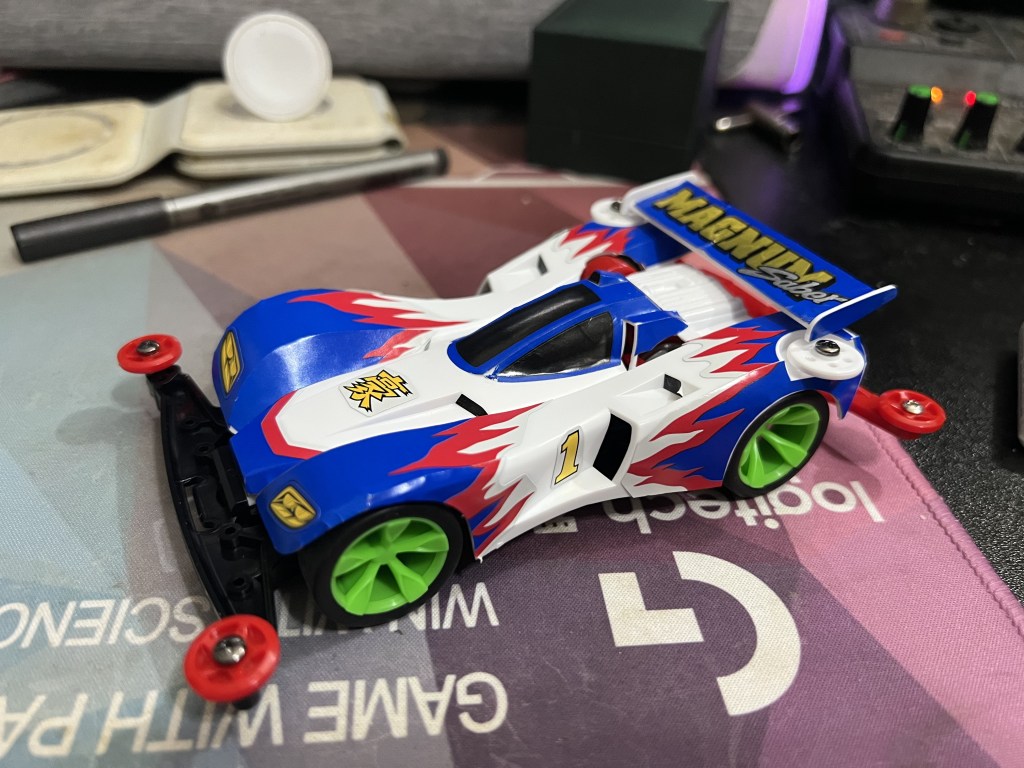
In my last entry, I mentioned that I had deliberately saved the Magnum Saber for a day when I could build it on my own and there’s a reason for that.
I’ve alluded to this a few times throughout this journal, but long before Geo Glider became the gateway drug that dragged me back into Mini 4WD there was another car. The Magnum Saber.
This was my Tamiya when I was a kid and I don’t remember every detail about building it. I couldn’t tell you what motor I had in it or what kind of chassis it had.
But I remember that chunky body. I remember those green wheels. I remember the name Magnum Saber.
And strangely enough, it was sitting there waiting for me the very first day I walked into Brickyard with my fiancée and bought the Geo Glider. I saw the box on the shelf and immediately recognized it and for a second, I genuinely considered buying it instead.
But something in me wanted to experience Mini 4WD again without immediately trying to recreate my childhood. I wanted to see what Tamiya had become while I was gone. Build different cars. Discover different chassis. Learn why grown adults were still obsessing over these tiny plastic machines decades later.
So I left the Magnum Saber on the shelf and decided to buy Geo Glider.
Ten entries later, I think I’ve finally earned my way back.
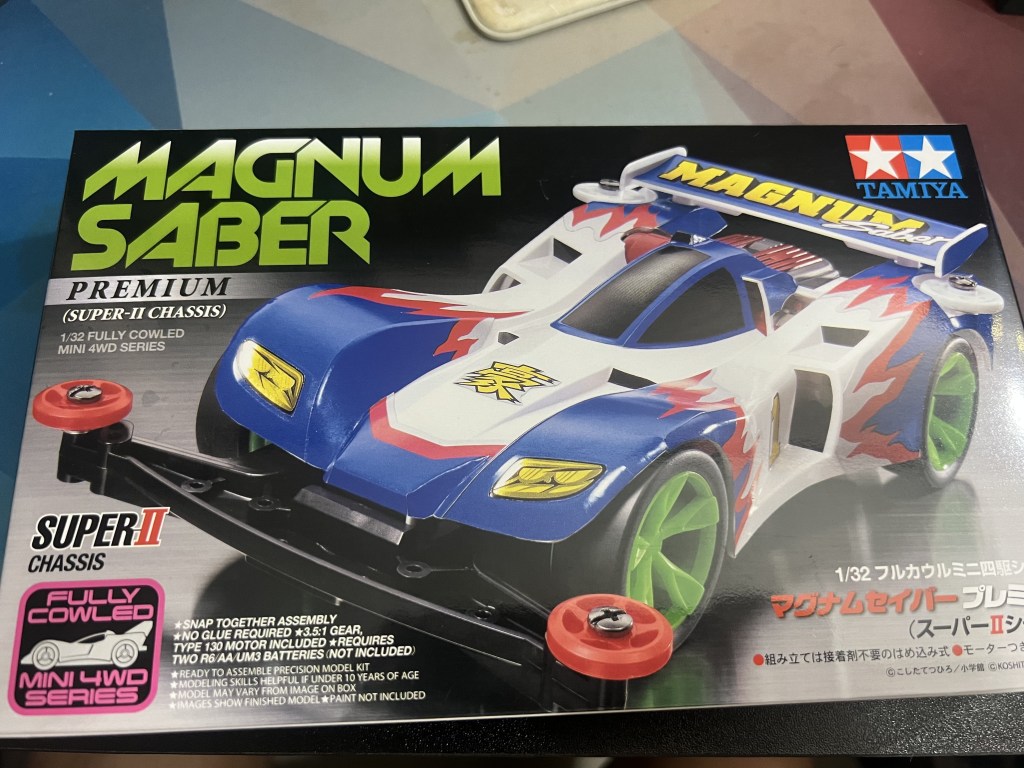
This particular kit is the Premium version, something I eventually learned meant I wasn’t actually building the exact same Magnum Saber I owned as a kid.
Underneath that familiar body was a Super II chassis, a modernized interpretation of the older chassis the Magnum Saber originally came with.
So technically, this wasn’t my Magnum Saber, at least not exactly.
But looking at the cowl and those familiar wheels, it was close enough to make something in my brain light up and I opened the box hoping that somewhere between all that plastic, I’d find a little piece of being a kid again.
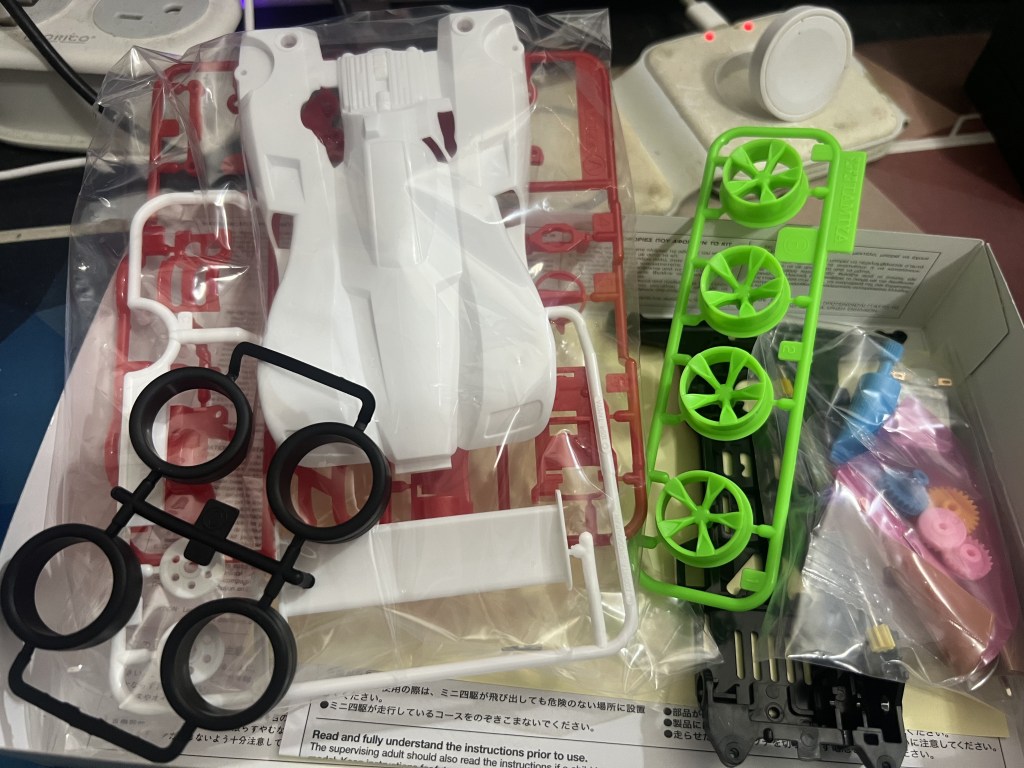
I’d already built a Super II chassis with the Ray Stinger, so mechanically, there wasn’t much here that I hadn’t seen before.
And I’ll admit it, Super II wasn’t exactly my favorite chassis.
After experiencing things like FM-A, AR, MA and MS, I’d gotten used to Mini 4WDs with clever battery access, elaborate drivetrains, modular sections and all sorts of interesting engineering.
Super II felt, simple. But for once, I didn’t mind. Actually, I loved it!
Usually, the build itself is my favorite part of this hobby. The finished car is almost just the reward at the end.
This time was different. I really wanted to see the finished car.
So I happily worked my way through the familiar Super II chassis, knowing exactly what was waiting for me at the end.
Then I picked up the cowl and noticed something I’d never paid attention to before.
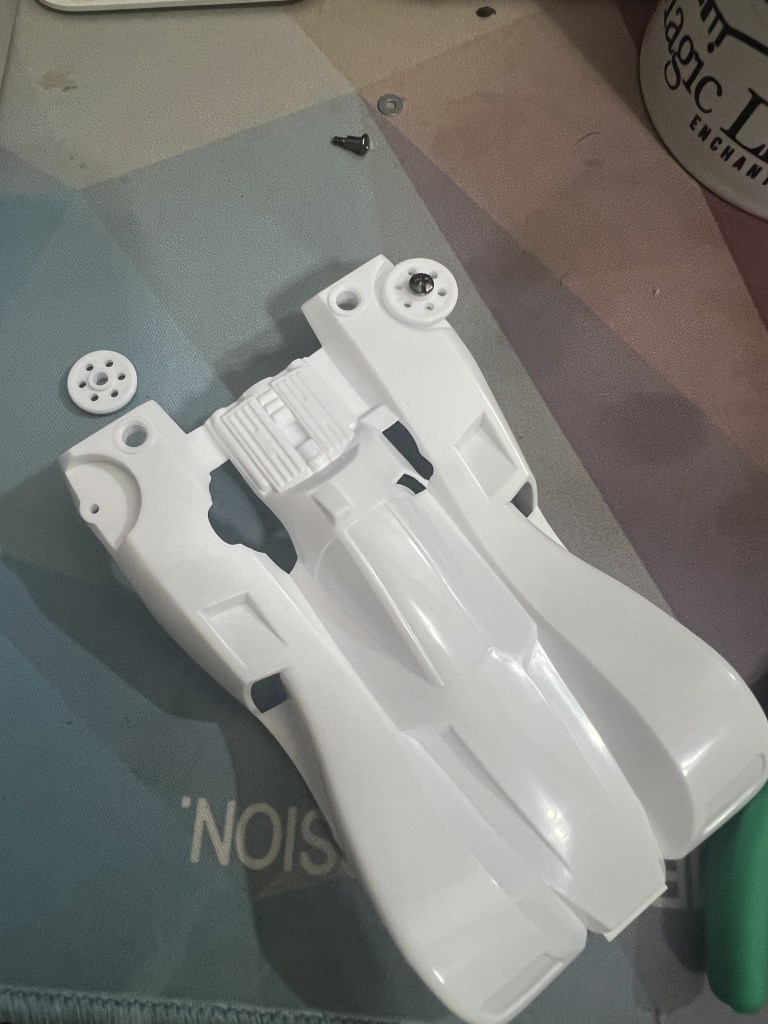
The rollers were attached to the cowl. Every Mini 4WD I’d built since getting back into the hobby had its rollers mounted to the chassis or bumper plates.
But Magnum Saber had two sitting directly on the body.
And then something clicked.
The original Magnum Saber didn’t have the kind of rear bumper I’d gotten used to seeing on modern chassis.
So where do you put the rear rollers? Apparently…
There.
It was such a tiny detail, but I loved discovering it.
Here I was building something because it reminded me of my childhood, and somehow it was also teaching me about how Mini 4WD itself had changed since then.
Things I now took for granted simply weren’t part of the design language yet.
And suddenly, the simplicity of the Super II started making a lot more sense.
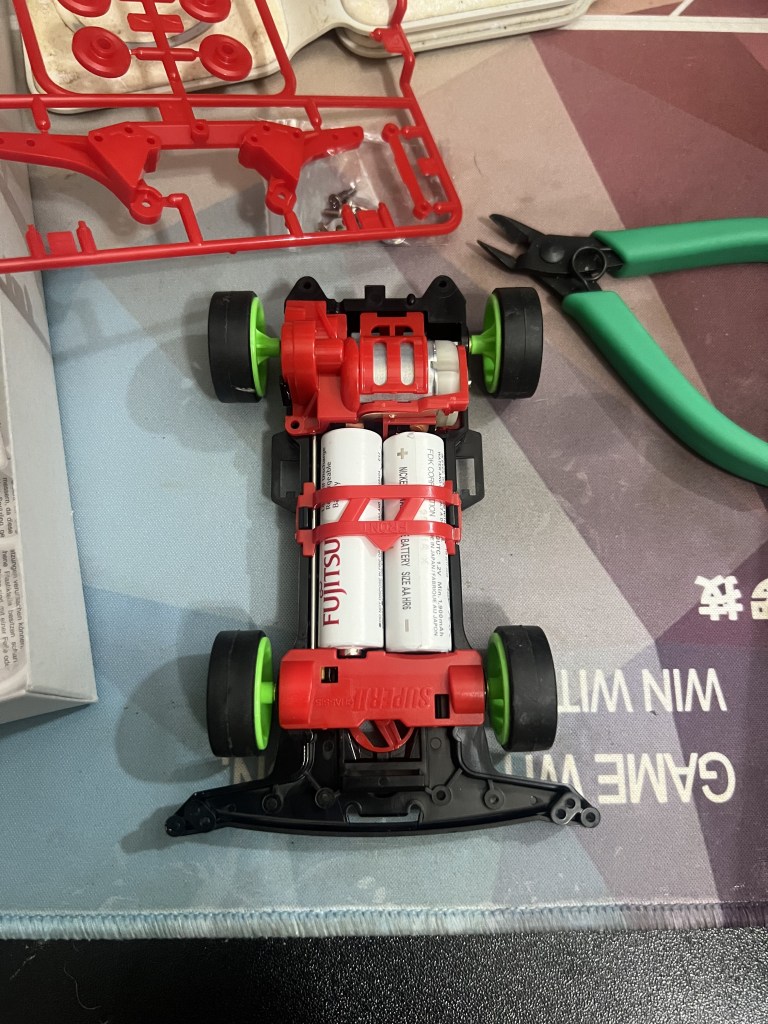
I found myself appreciating the Super II more than I ever had before. Not because it suddenly became more sophisticated but because now I had context.
I’d spent the last several builds fascinated by how Tamiya had evolved these cars. Mid-mounted motors. Front-mounted motors. Modular chassis. Brake systems. FRP plates.
Magnum Saber reminded me what came before all of that.
Simple yet somehow, charming because of it.
I saved the cowl for last and I took my time with the stickers, carefully placing each one where it belonged.
There was no rush anymore. I knew exactly what I was building toward.
Then I finally lowered the finished body onto the chassis.
And there it was.
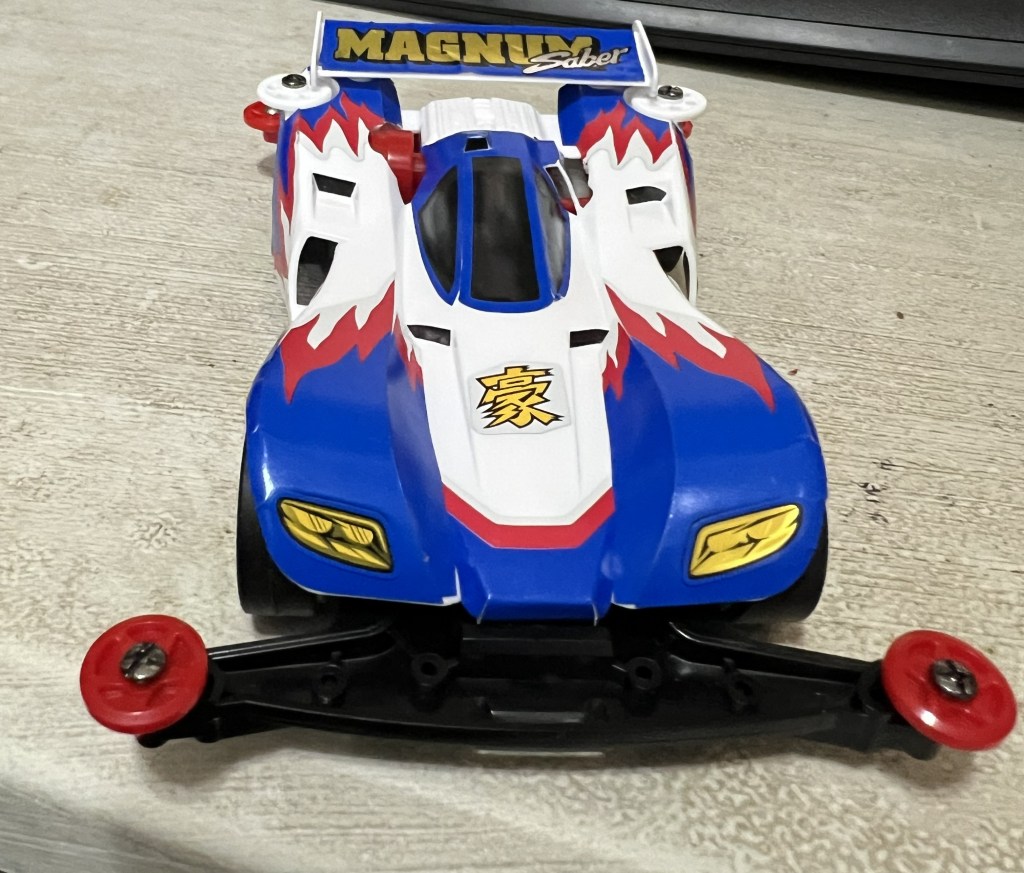
I put Magnum Saber down on the table and just looked at it for a while.
And suddenly I remembered things I hadn’t thought about in years.
Stealing batteries out of clocks around the house, much to my mom’s dismay.
Letting my Tamiya loose on the street and chasing after it, desperately hoping it wouldn’t get run over.
Playing with it even when there weren’t any batteries inside.
Back then, I didn’t know anything about chassis. I didn’t know what B-MAX was.
I didn’t know about motor break-in, rollers, brakes, gear ratios or any of the things I’ve spent the last few months obsessing over.
It was just my little car and I loved it.
That’s probably what surprised me most about this build.
When I first returned to Mini 4WD, the Super II chassis didn’t excite me very much. Compared with the modern chassis I’d started discovering, it seemed almost too basic.
But Magnum Saber made me appreciate that simplicity.
Not everything needs to surprise me. Not every box needs to introduce a new piece of engineering.
Sometimes the finished car matters just as much as the journey getting there.
And after spending ten entries learning my way through Mini 4WD, it felt really good to come home.
Historian’s Note
The Magnum Saber I remembered from childhood wasn’t actually built on the Super II chassis. This Premium version updates the classic design with a newer chassis while keeping that unmistakable Magnum Saber body.
That’s probably why this build felt so strange in the best possible way.
The car on top belonged to my childhood.
The chassis underneath belonged to the hobby I was rediscovering as an adult.
Somehow, they met in the middle.


Leave a Reply