Seven blogs in, seven different Mini 4WDs, and I’ve somehow managed to avoid doing the one thing everyone in this hobby is apparently supposed to do with them: race.
Now, that doesn’t mean I haven’t been slowly getting pulled into the racing side of the hobby. By this point, I’ve watched tournaments, races, cups, and probably way too many random videos of other people tinkering with their cars. Every racer seems to have their own little machine, customized exactly the way they want it.
And now I’m thinking: I’m ready to get my own little car onto that track.
For my first race, I wanted the full experience. Go to a hobby shop, pick out a box, build it right there alongside everyone else, and race whatever came out the other end.
So when I headed back to Brickyard, I picked out the best one I could find.
And boy, did I find it.
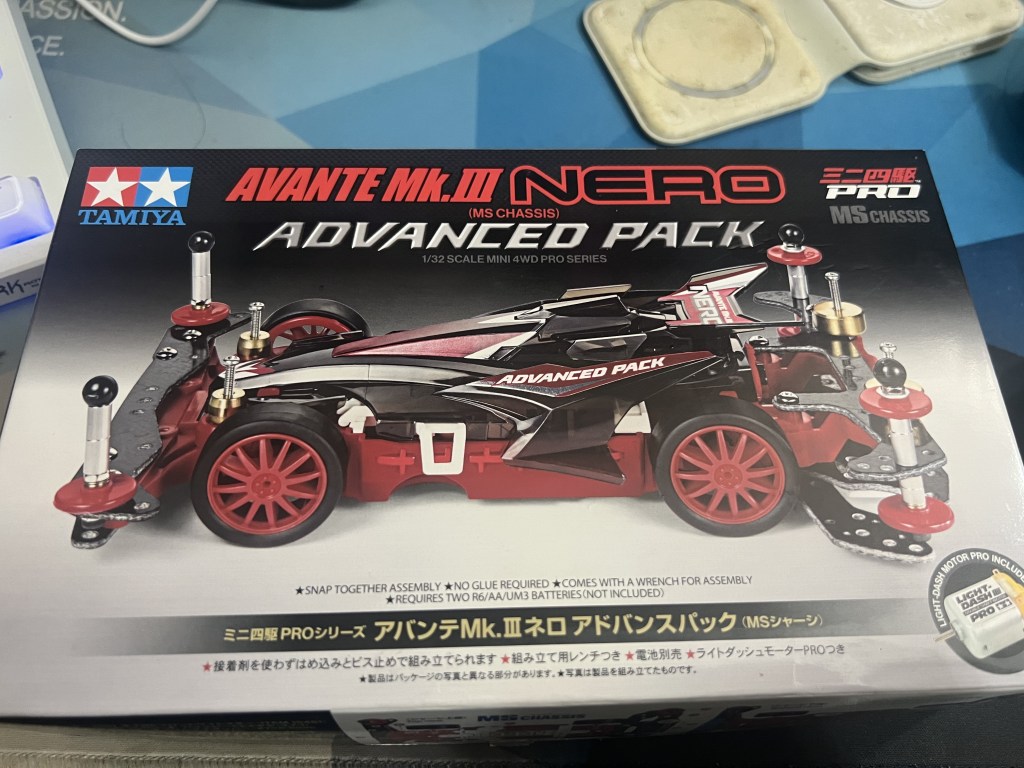
What a box. Everything about it just inspired confidence.
“Now THAT’S a racing machine.”
Having recently built my first MS chassis with the Thunder Shot, I already had some idea of what the build would be like. But this was also my first “Advanced Pack,” which immediately raised another question: how different was this going to be from the Starter Packs I’d built before?
Would there be more parts? More things to tune? More things for me to install incorrectly?
I turned the box around.
There were certainly more things.
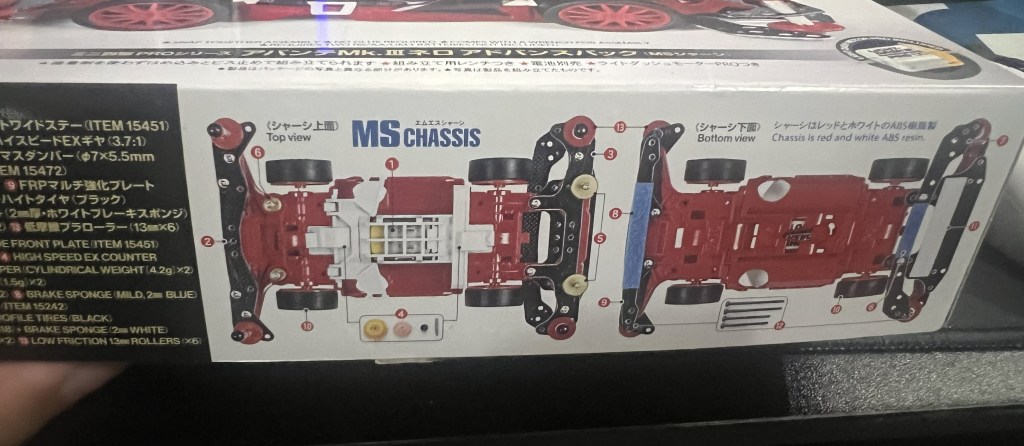
That was all the convincing I needed.
I went to the register and, after paying, the staff asked me something I’ve always said no to before:
“Sir, are you building it here?”
For the first time ever, I said yes.
They handed me my box, and I found myself a tiny corner of the long table. On the other side were a few guys who clearly knew what they were doing. Their Tamiyas were surrounded by tools I couldn’t even identify. They had electronics hooked up to motors, towering cases full of Mini 4WDs, battery stations triple the size of mine, the works.
Across from me was a kid who couldn’t have been older than ten, sitting beside his dad with a toolbox bigger than mine. He had four different Tamiyas laid out in front of him, all with custom rollers and parts.
Meanwhile, I had my tiny toolkit, a grease pen, and one unopened MS kit.
It was a little intimidating.
But weirdly, I also felt like I belonged there. Everyone at that table was there for the exact same reason I was.
I opened the box and got to work.
And somewhere along the way, I finally understood why this thing was called an “Advanced Pack.”
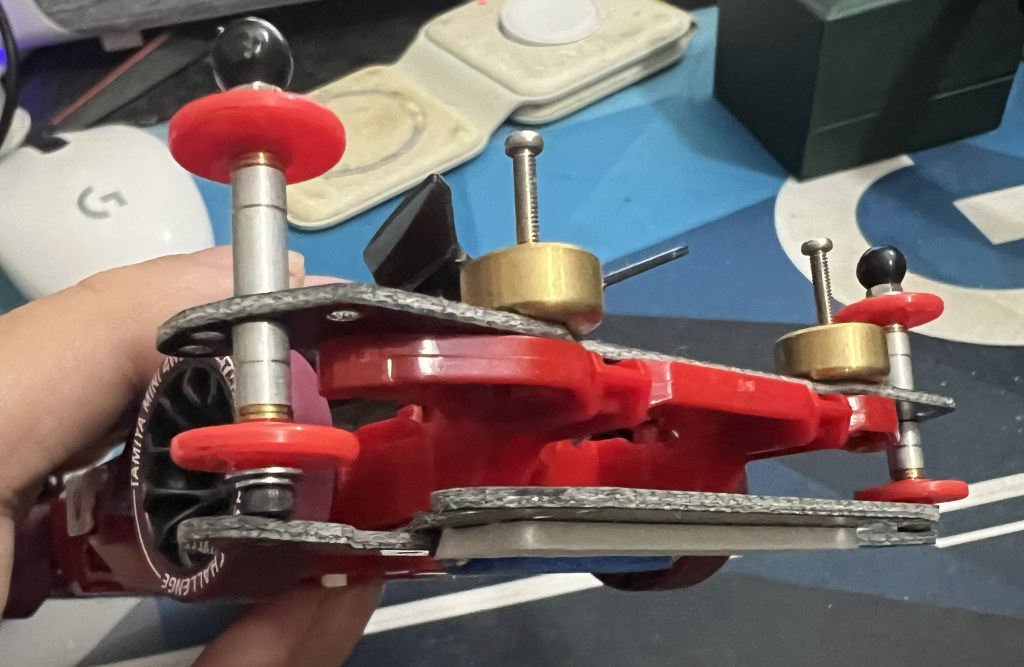
Assembling the MS chassis itself was almost a cakewalk after the Thunder Shot. But the bumper plates were a completely different beast.
I was still mostly following the instructions blindly at this point, but as I painstakingly pieced everything together, I started understanding what each part was actually doing.
Why are there spacers here? Why does this screw have to go in that order? Why are there weights on the front? Why are there weights on the back?
For the first time, I wasn’t just assembling a Tamiya.
I was beginning to understand one.
There was one thing, though, that I still couldn’t wrap my head around.
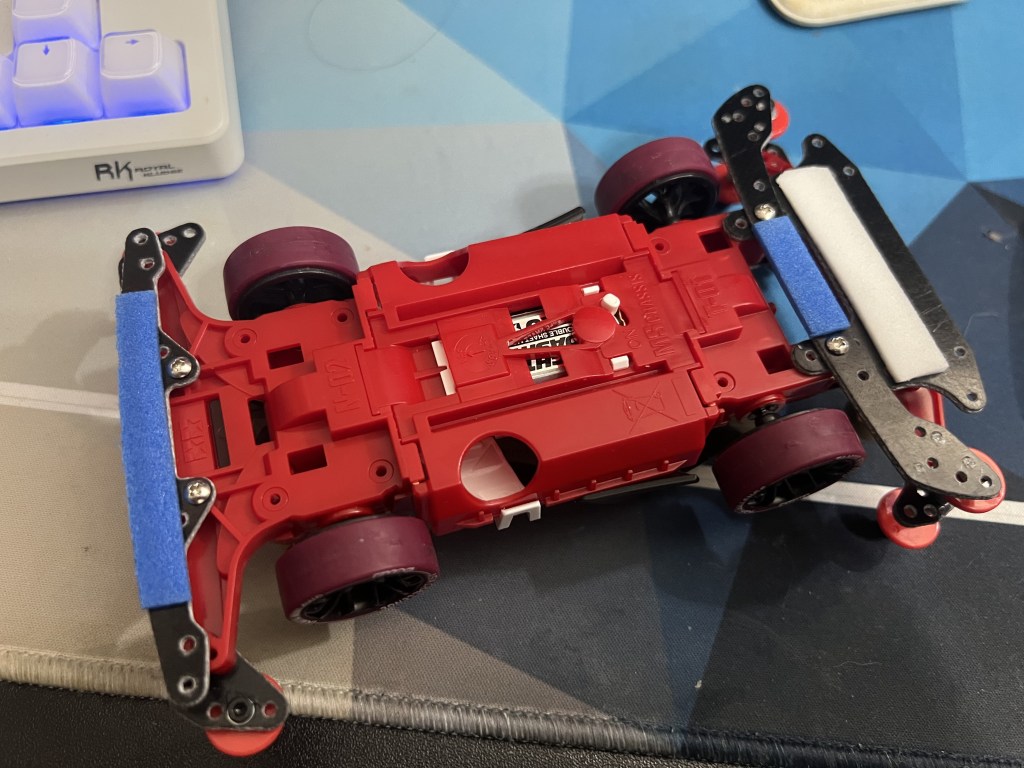
“Why am I putting THREE different brake pads on this thing?”
Won’t these just slow the car down?
I hesitantly stuck them on anyway. At this point, I was still very much a follower of the sacred text known as the instruction manual. If Tamiya told me to put three brake pads on it, three brake pads it would get.
Still, I made a mental note: if these things cost me the race, one of them was coming off.
After a lot of tinkering, the chassis was finally starting to look race-ready.
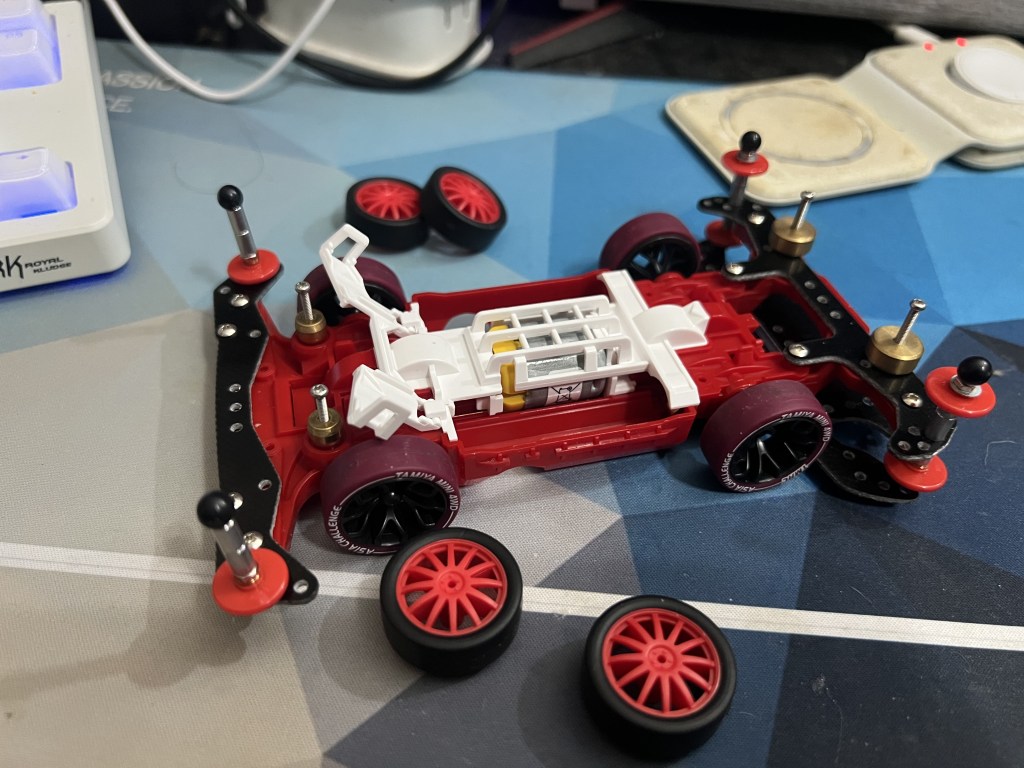
At some point, the kid sitting across from me walked over.
“Hey! I have one of those!”
He dug through his toolbox and proudly pulled out his own Avante Nero Mk. III.
It was an exact copy, right down to the last screw.
“Great minds think alike!” I joked.
Internally:
Crap. Someone else has this.
I went straight to the shelves to see what I could change. Given that I was still very new to customization, I chose the safest possible option.
Wheels.
I grabbed Nero some fancy new shoes.
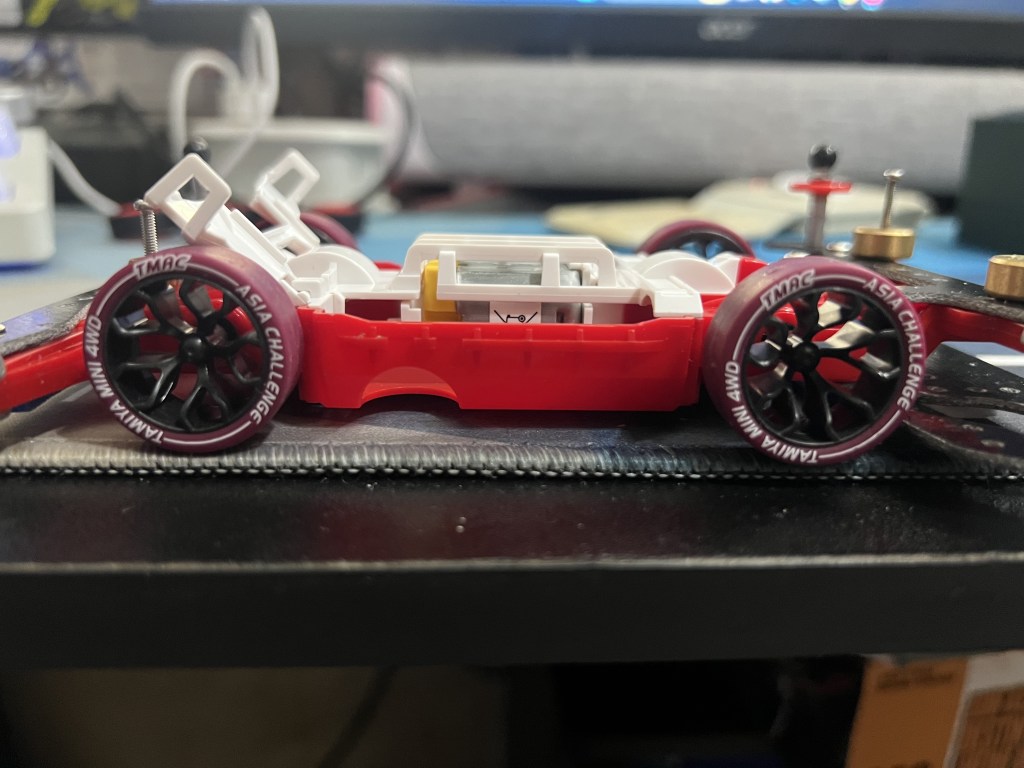
The moment I put them on, I felt strangely closer to this little machine. Somewhere in the world, someone obviously had another Avante Nero, probably thousands of people did, but this one was mine.
And to anyone who sees this blog and says “well I have the same one with those exact wheels”, no you don’t. Satisfied with my first tiny customization, I moved on to the cowl.
And somehow, this kit still had surprises left.
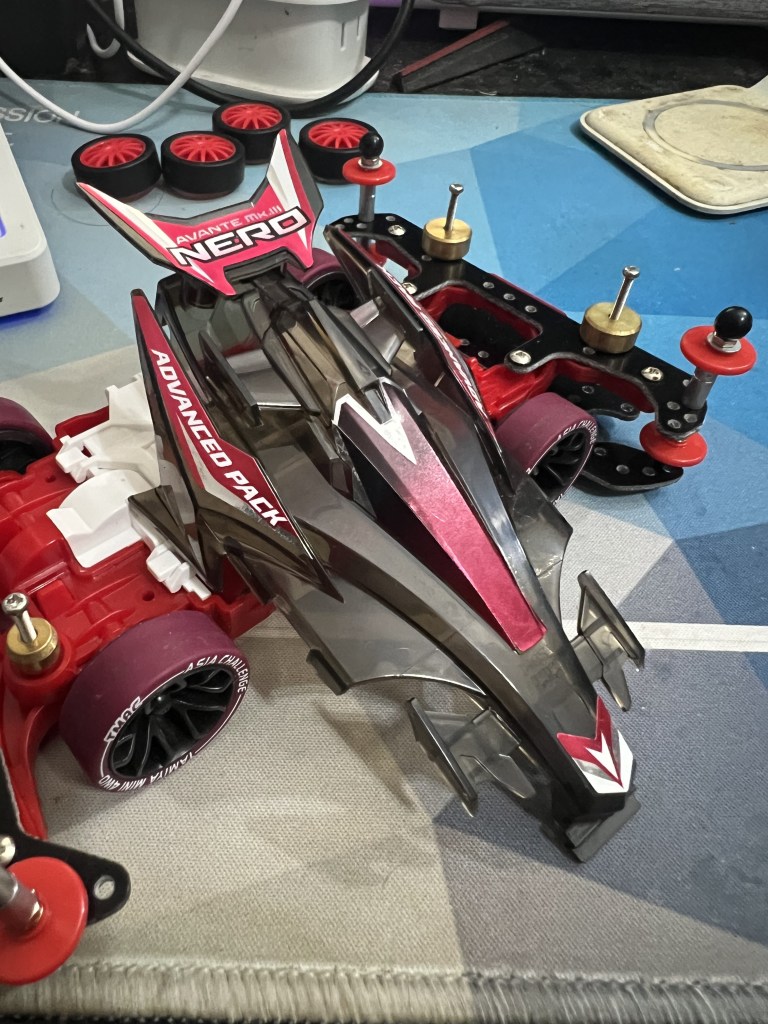
That cowl is chef’s kiss gorgeous.
The stickers were relatively minimal, but that smoky, semi-transparent plastic brought the whole thing together. The deep red chassis and maroon wheels were still visible underneath, while the black and pink body sat over everything like tinted glass.
If I weren’t planning to race this thing, I probably would’ve picked it as one of my best-looking builds so far.
I placed the cowl on the chassis, reached for the usual plastic lock…
And there wasn’t one.
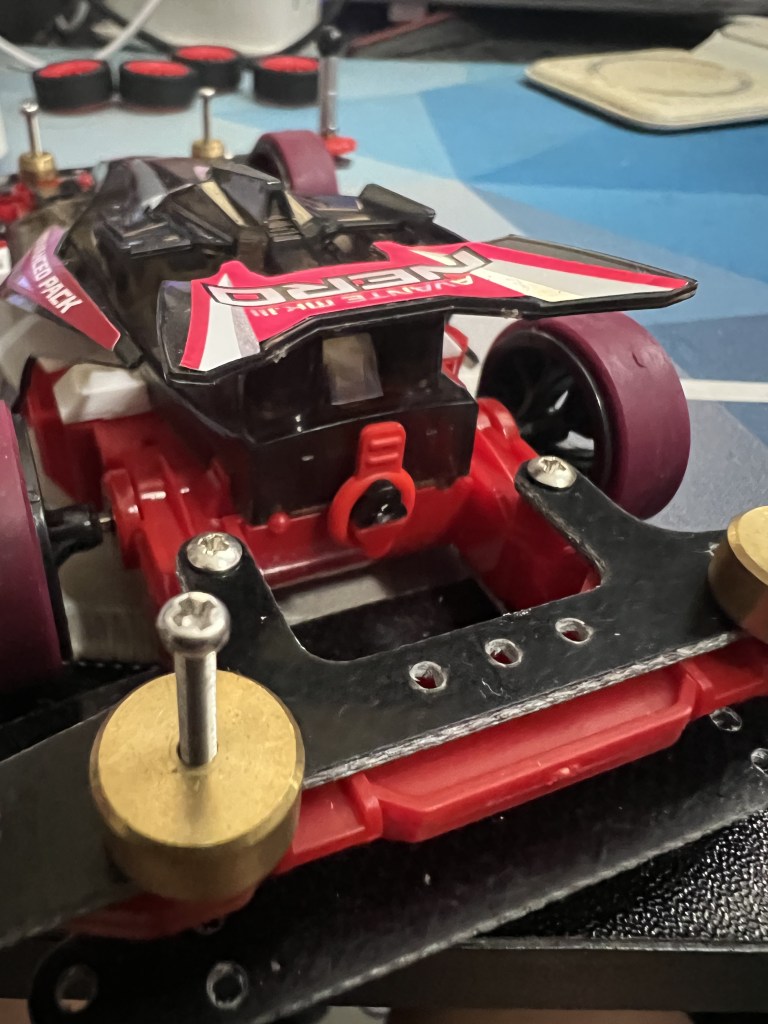
Usually, the cowl is held onto the chassis by a plastic lock that twists into place. Not here.
Nero uses this tiny rubber tab.
At first I thought it was strange, but then I looked at everything packed around the rear of the car. With the extra plates and hardware from the Advanced Pack, a normal plastic lock would’ve been awkward to reach.
This little rubber tab simply stretches between the rear plates and hooks into place.
“That is genius.”
Such a tiny solution to a problem created by everything else they had added to the car.
I spent more time admiring that little piece of rubber than I probably should have.
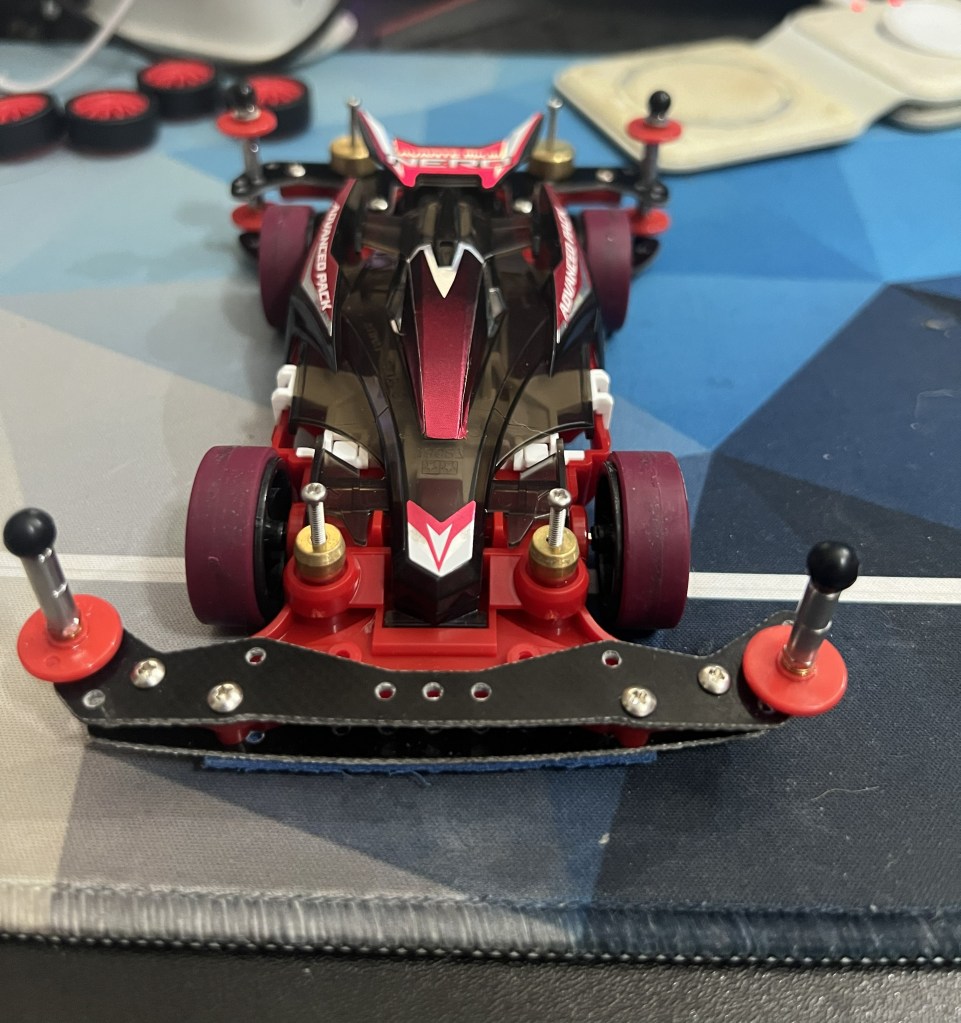
And just like that, Avante Nero was done.
What a stunning little machine.
The maroon wheels I picked out fit it almost too well, and for once, finishing the build wasn’t the end of the experience.
I actually came here to race.
So I packed up my tools, carried Nero over to the track, and joined the line.
There was already a huge line.
One by one, people placed their cars on the track and watched them disappear around the course. Some looked ridiculously fast.
Eventually, it was my turn.
I walked up carrying my freshly built Nero and lined up against two other cars: a Mach Frame and another model I didn’t recognize.
The referee counted us down.
Three.
Two.
One.
Go.
All three cars shot forward.
And immediately, I realized something.
Nero was not the fastest car on that track.
The Mach Frame was absolutely flying. I watched it zip through each section while Nero steadily followed behind. For the first lap, I was convinced I was about to lose my very first race.
Then, on lap two…
The Mach Frame flew off the track.
Eliminated.
Suddenly there were two.
The other car was still faster than Nero, too. I figured second place wasn’t bad for my first race.
Then that car flew off as well.
I looked back at Nero.
Still going.
Not particularly quickly.
But still going.
And then it crossed the finish line.
I won.
By sheer beginner’s luck, the slowest car in the race was the only one that actually finished it.
I picked Nero up and walked back toward the table, trying very hard to look like this was a completely normal occurrence for me.
Inside, I was ecstatic.
I overheard the guys who I just raced chatting over on the on the other table and say “I should have put another brake here, I could have won that last one.”
And then it hit me, the brakes!
Those extra brake pads I had questioned during the build, the ones I thought would slow me down, had helped keep Nero stable enough to actually finish the race.
Turns out, sometimes the fastest car doesn’t win.
Sometimes it just needs to stay on the damn track.
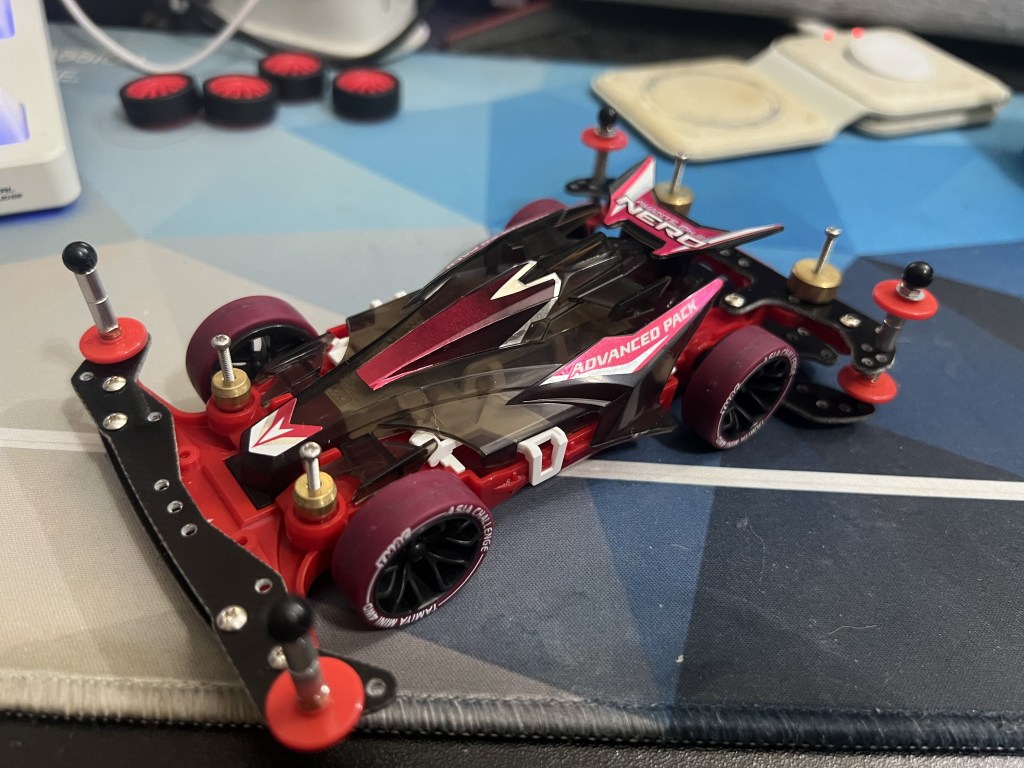
Looking back, Avante Nero was a special build for more reasons than just winning my first race.
I built it at Brickyard surrounded by people who were much deeper into the hobby than I was. For the first time, I customized a car, even if it was just a set of wheels, and actually felt like I was making something uniquely mine.
And I finally learned something that should have been obvious from the beginning:
Going fast isn’t the same thing as racing well.
Brake pads, stability, weight distribution… suddenly all these things I had been blindly screwing onto my cars started making sense.
More importantly, I finally raced one of these things.
Seven builds spent wondering what all these parts were for, and on number eight, I finally found out.
My first race.
My first customized car.
My first win.
Beginner’s luck?
Absolutely.
But I’ll take it.
Historian’s Note
Looking back, I understand this build a lot more now. The MS Chassis stands for Midship, with the motor sitting right in the middle and the chassis itself split into three sections, making it great for tinkering and customization.
The Advanced Pack was also basically my first taste of a race-ready Tamiya. All those plates, weights, rollers, and the three brake pads I kept questioning actually had a purpose.
Turns out, brakes aren’t just there to slow you down. They help keep the car under control through slopes and jumps.
So yes, beginner’s luck won me that race.
But apparently, so did those stupid brake pads.
 The Tamiya Journey Journal
Leave a comment