
Every hobby has its expensive lessons.
This was one of mine.
As my Mini 4WD collection slowly grew, I started noticing that some kits were much harder to find than others. Two in particular kept slipping through my fingers. Every time they appeared online, they’d either sell out almost immediately or cost far more than I was willing to spend.
They weren’t just any two kits.
They were machines straight out of Bakusou Kyoudai Let’s & Go!! and Dash! Yonkuro.
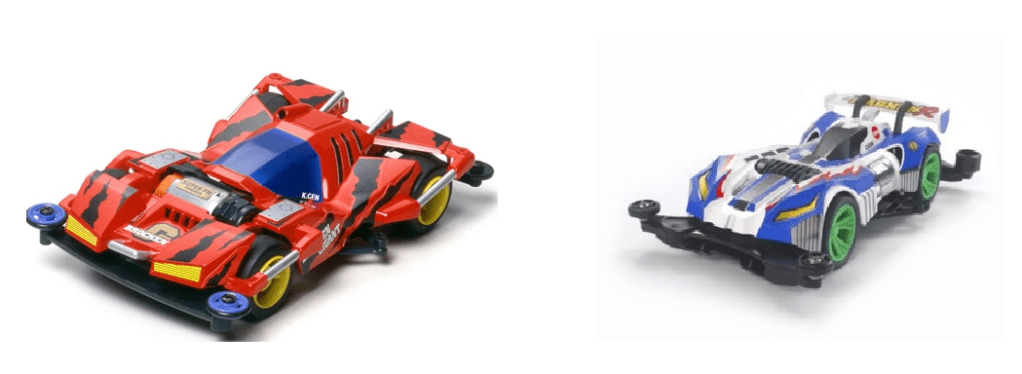
Both of these kits happened to use the FM-A chassis, which had already become one of my favorites. Naturally, I wanted them alongside the rest of my collection.
I kept asking around and searching online, but I kept hearing the same advice:
“Just have it shipped from Japan.”
At the time, I wasn’t quite ready to spend that kind of money.
Eventually, I found both kits online.
There was just one catch.
They were obvious bootlegs.
The price was much lower than anything else I’d seen, and some of the colors weren’t even accurate to the originals.
I remember telling myself,
“How bad could they really be?”
So I ordered them anyway.
When they arrived…
More red flags started popping up.
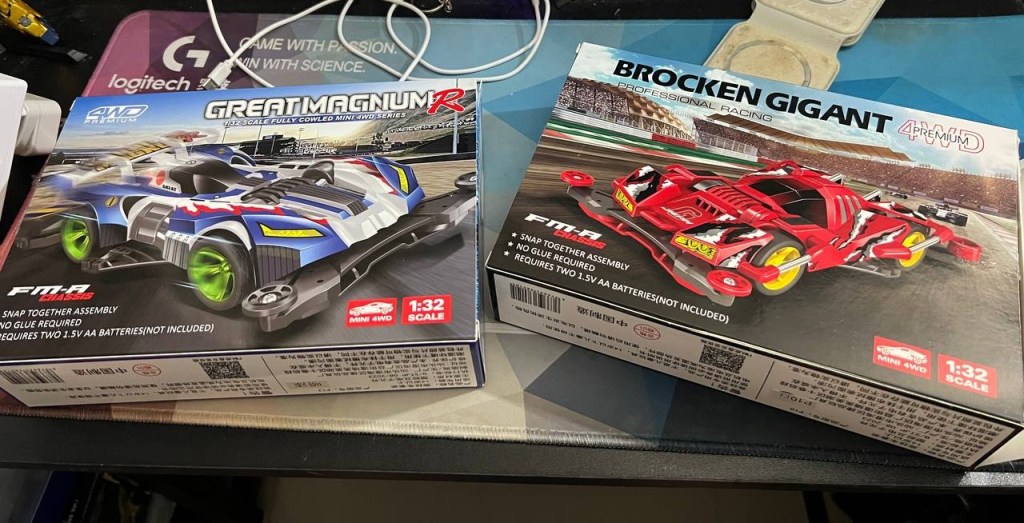
The boxes immediately felt different.
Instead of the familiar Japanese text, there was Chinese printed along the bottom. The artwork looked just a little off, and instead of opening from the top like every Tamiya kit I’d built before, these opened from the side.
But honestly…
I already knew these weren’t genuine.
At that point I figured I might as well lean into the experience and see just how different they really were.
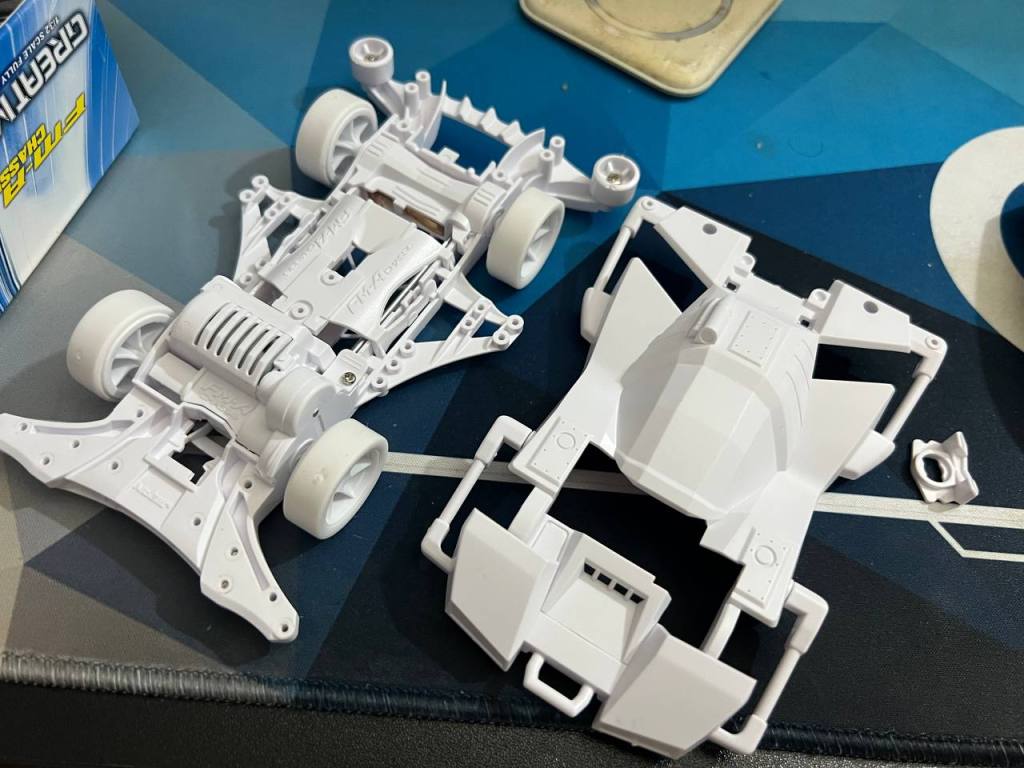
Now I actually liked that the colors were different. This white theme looks amazing! But, the red flags came before I even started building.
Everything arrived inside one giant plastic bag.
Parts.
Wheels.
Screws.
Stickers.
All jumbled together.
The instructions were still there, but finding the right parts felt more like solving a puzzle than following a manual.
The plastic itself also felt noticeably flimsier.
It wasn’t terrible…
But it definitely didn’t inspire confidence.
Some of the screws and rollers were missing too.
Oddly enough, though, I barely needed the instructions anymore.
Somewhere along the way I’d learned enough to recognize most of the parts from memory.
That was a nice realization.
Even if the kit wasn’t.
At the end of the day, I still liked how it looked at least. If the plastic quality had matched the real thing, I probably would’ve even loved this.
Then I got to the motor.

I’d never seen a motor with holes cut into the casing before.
My first thought wasn’t,
“That’s interesting.”
It was,
“Is… is this safe?”
Testing them only made things stranger.
One motor sounded perfectly fine.
The other sounded like someone had dropped a handful of screws into a blender.
I lubricated the gears.
I swapped motors.
I checked the drivetrain.
Nothing fixed it.
Eventually I accepted that something was simply wrong with it.
Then I reached the body.

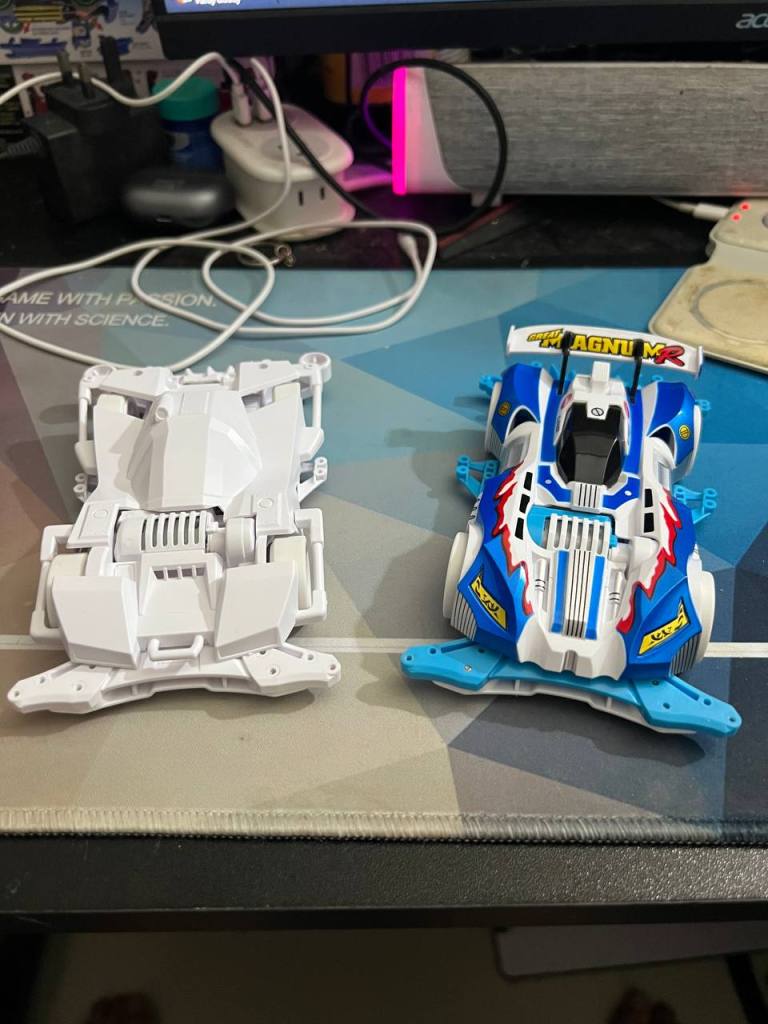
The body came pre-painted.
At first I thought that was a nice bonus.
Then I realized something.
One of my favorite parts of building Mini 4WDs besides actually assembling the car is applying the stickers.
Taking my time.
Making tiny adjustments.
Trying to line everything up perfectly.
It’s strangely relaxing.
With a pre-painted body, that entire experience was already done for me.
The finished result looked fine.
But somehow…
It didn’t feel earned.
And surprisingly,
I missed that part the most.
Looking back, I’m actually glad I bought these.
Not because they were amazing kits.
They weren’t.
But they taught me something I probably needed to learn early.
Collecting isn’t a race.
Sometimes the right answer really is to wait.
Now I know that when I finally find genuine versions of these two kits, I’ll appreciate them far more than I ever would have if I’d settled for the easy option.
Some things are worth waiting for.
Historian’s Note
Every collection has pieces you’re proud of.
And every collection has pieces that teach you something.
These weren’t the cars that made me fall in love with Mini 4WD.
They were the cars that taught me patience.
Looking back, I don’t regret buying them.
Without these bootlegs, I don’t think I would’ve appreciated the genuine articles nearly as much.
And when the day finally comes that the real versions find their way onto my shelf…
I already know they’ll be worth the wait.
 The Tamiya Journey Journal
Leave a comment