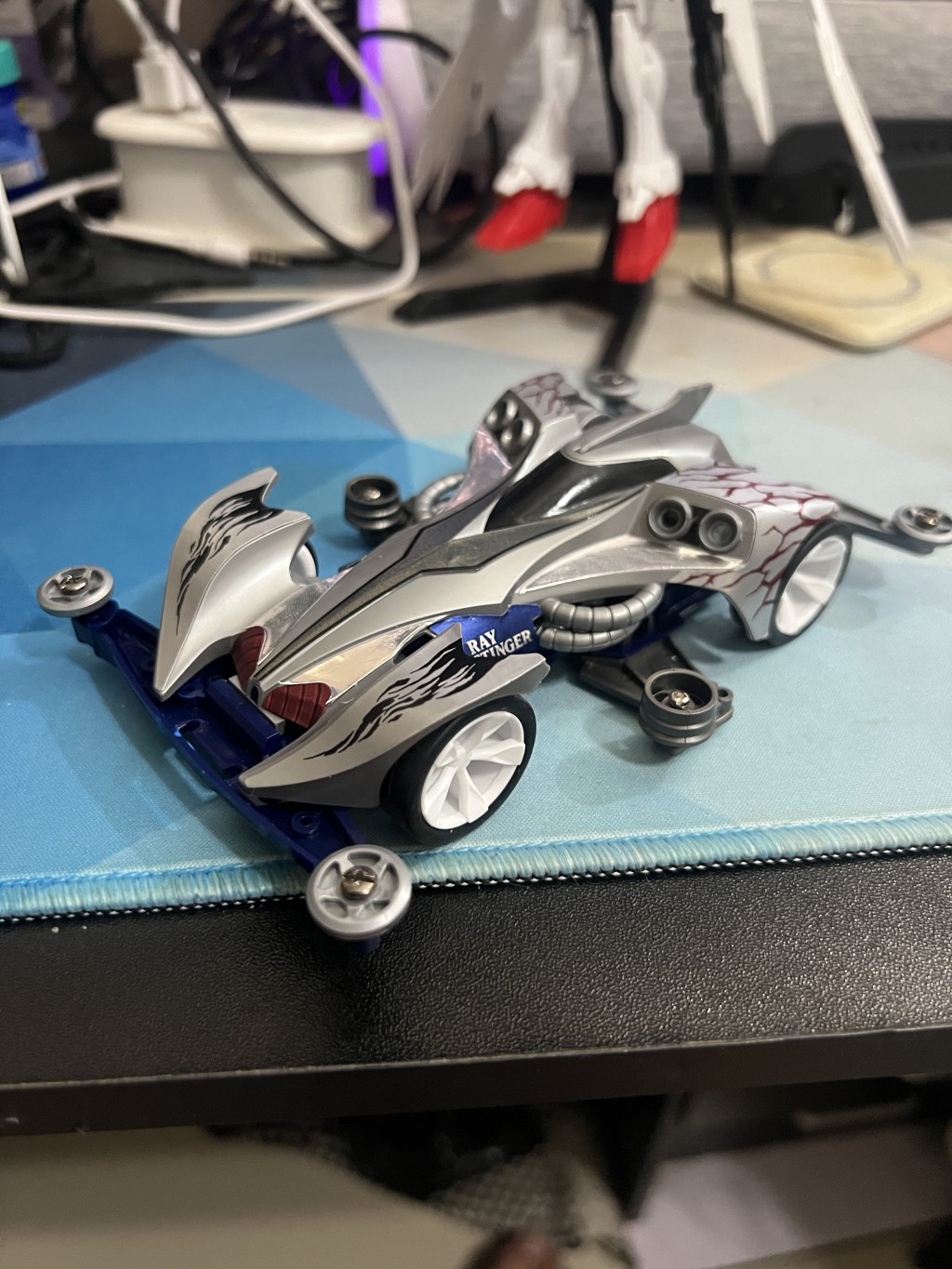
Shortly after building my first Mini 4WD, I was already looking for the next one.
That was when Ray Stinger entered the picture.
This time, I did not go back to Brickyard. I found the kit online from someone selling a few older Tamiya kits. Unlike my first purchase, where I simply picked the coolest-looking car on the shelf, I was starting to pay attention to what was actually written on the box.
One label immediately caught my attention:
SUPER II CHASSIS
“Super II?” I thought. “Is this a sequel? Was there a Super I?”
I still had no idea what the different chassis names meant, but I was starting to notice that not every Mini 4WD was built the same way.
Then I saw the side of the box.
Something about it instantly felt familiar.
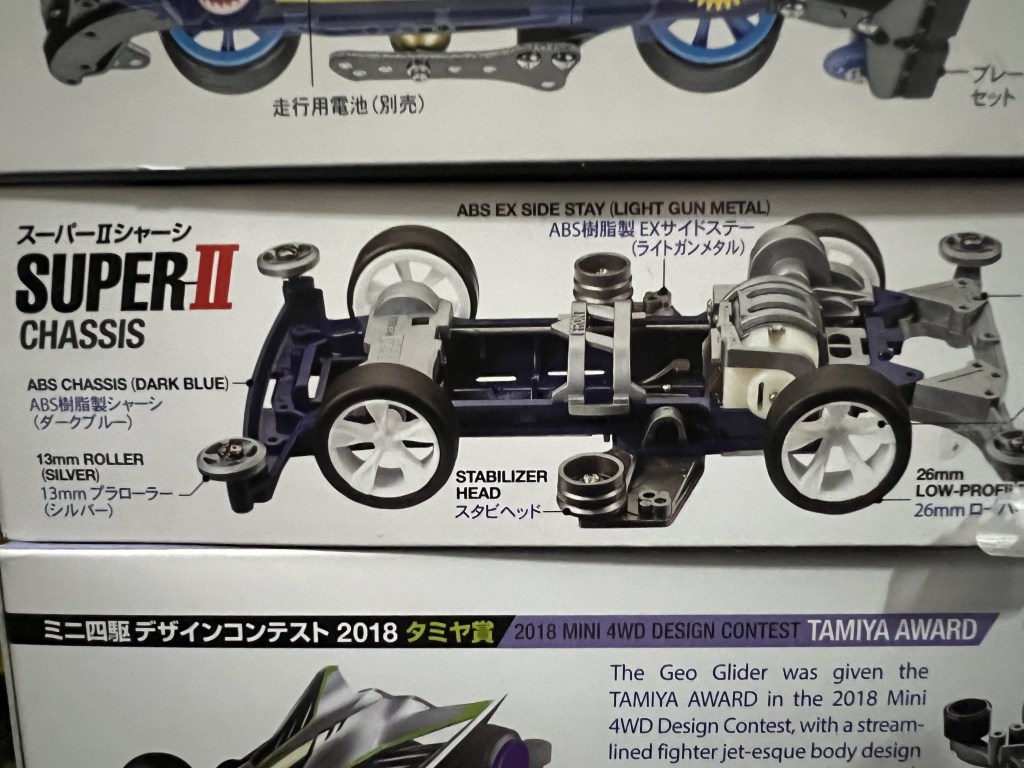
“Wait a minute. That looks exactly like how my old Tamiya used to look.”
I could barely remember the car I owned as a kid, but I remembered one important detail. The motor was positioned at the back.
The Geo Glider felt like a modern version of Tamiya. Its FM-A chassis looked wide, sturdy, and more complicated than what I remembered.
Ray Stinger looked like the Tamiyas from my childhood.
That was enough to convince me.
The seller was also based within Metro Manila, so after one GrabExpress booking, the box was already on its way to me.
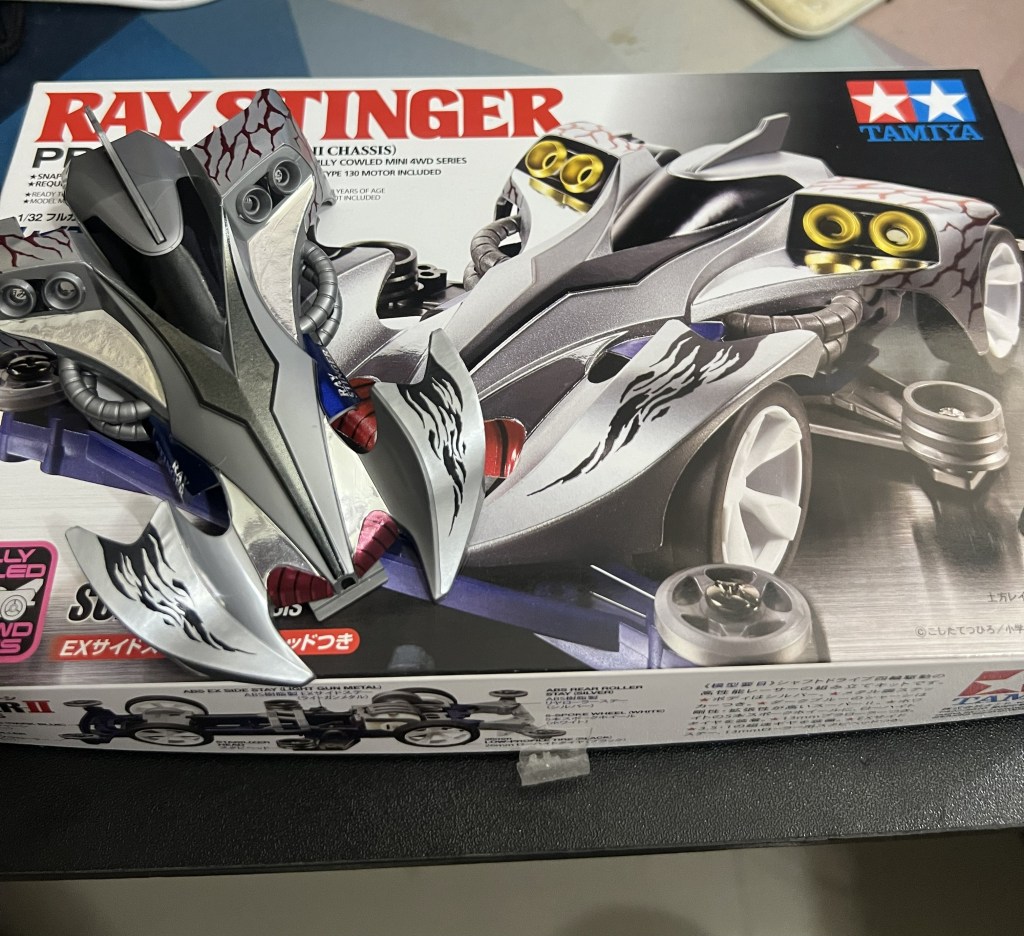
The first thing I noticed when I held it was how light it felt.
The box felt so much lighter than the Geo Glider that I briefly wondered if I had accidentally bought a bootleg.
I checked the packaging, looked at the logos, and inspected the box from every angle.
Thankfully, it looked legitimate.
The second thing I noticed was the body.
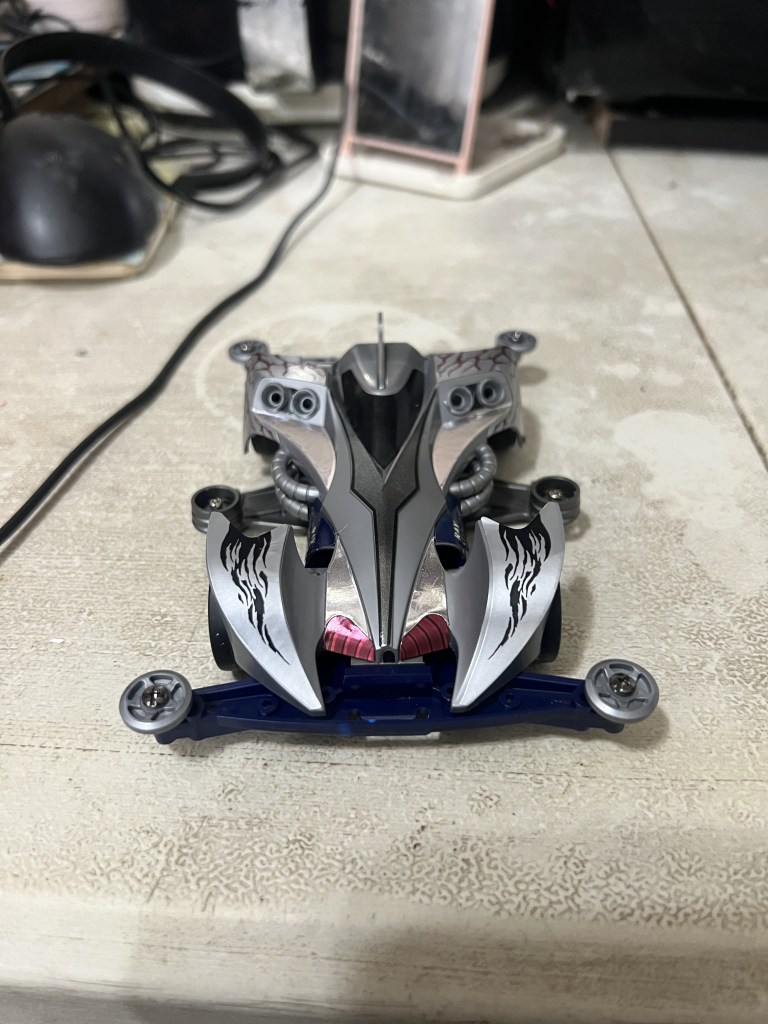
Ray Stinger looked much more dramatic than the Geo Glider. It had sharp silver panels, black flames, exposed mechanical-looking details, and a much more aggressive shape.
It looked like a villain’s car.
I could barely remember what happened in the old Mini 4WD anime, but I felt fairly confident that whoever owned this machine probably was not the cheerful protagonist.
Anyway, I opened the box and started building.
Almost immediately, I began comparing it to the Geo Glider.
The chassis felt smaller.
The parts felt lighter.
The entire assembly seemed much simpler.
I think I finished the basic chassis in less than thirty minutes.
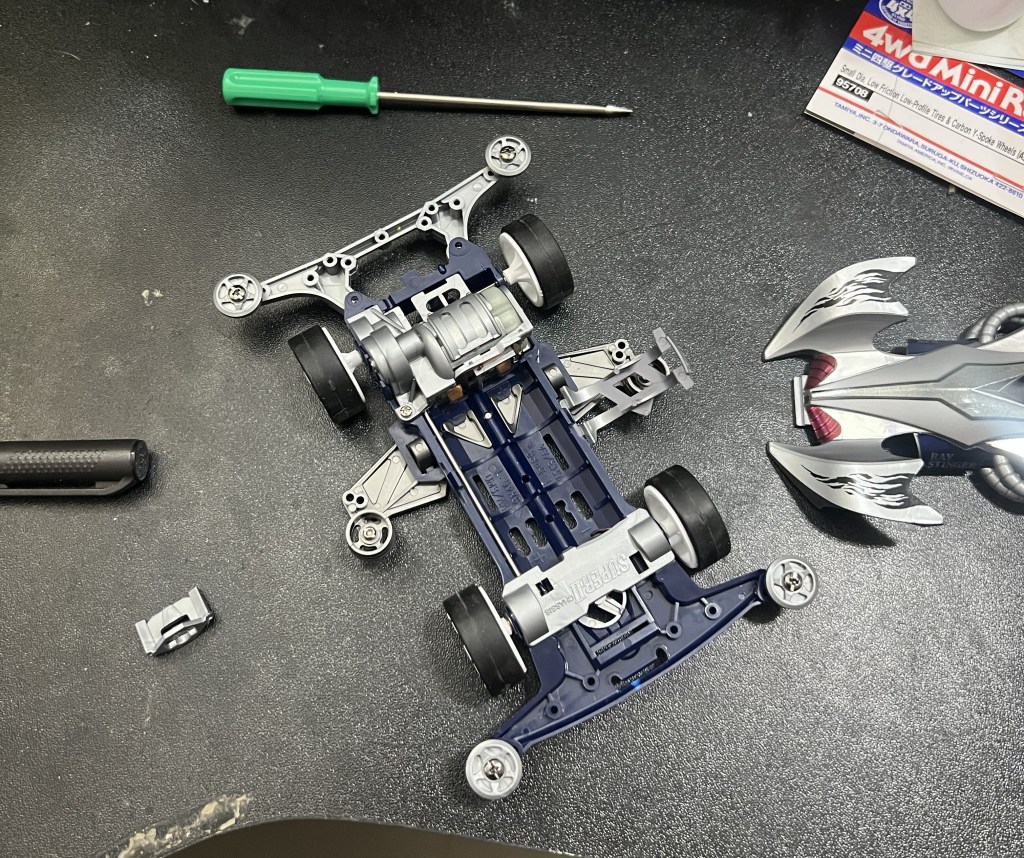
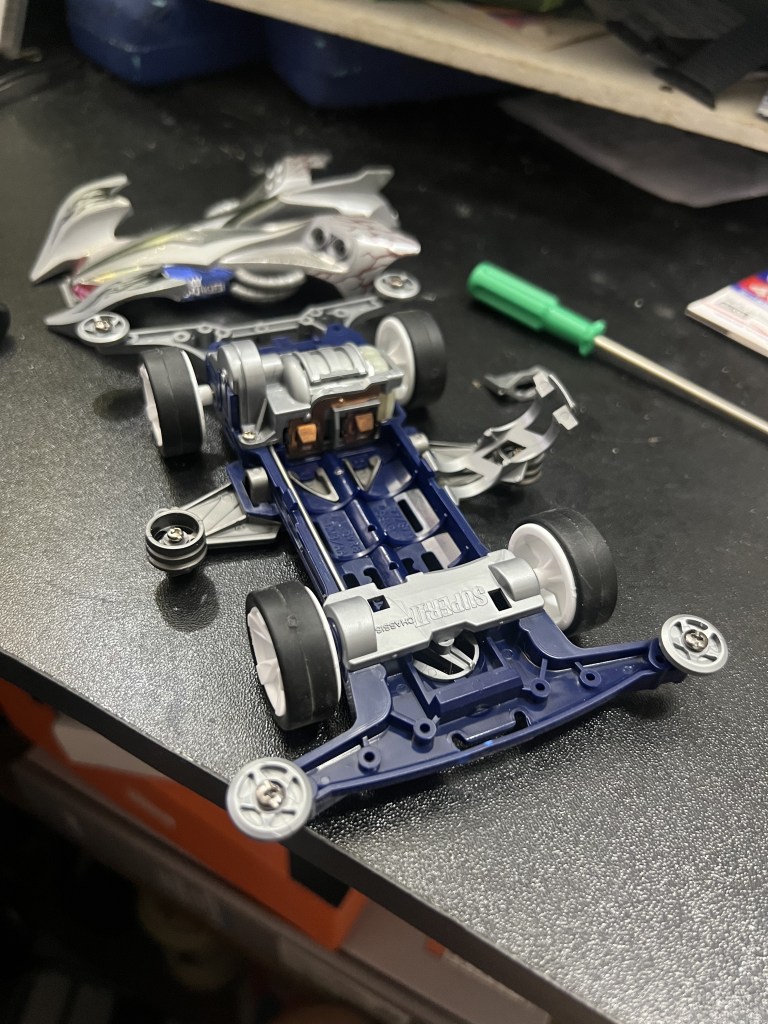
Before attaching the body, I spent some time just looking at the chassis.
The simplicity was what made it interesting.
The motor sat at the rear, just like the Tamiya I remembered from childhood. The layout felt direct and easy to understand. Compared to the FM-A chassis, there seemed to be much less happening underneath the car.
At first, I thought that might make the build less satisfying.
Instead, it made me appreciate it in a completely different way.
The Geo Glider showed me how modern and engineered a Mini 4WD could feel.
Ray Stinger showed me where that design language came from.
It felt like a bridge between the cars I remembered as a kid and the hobby I was now rediscovering as an adult.
Maybe the simplicity was intentional. These kits were originally made for younger builders, after all. The car needed to be easy enough for a kid to assemble and start playing with right away.
Or for a tired parent to finish after the kid gave up halfway through.
Unfortunately, the stickers were a completely different story.
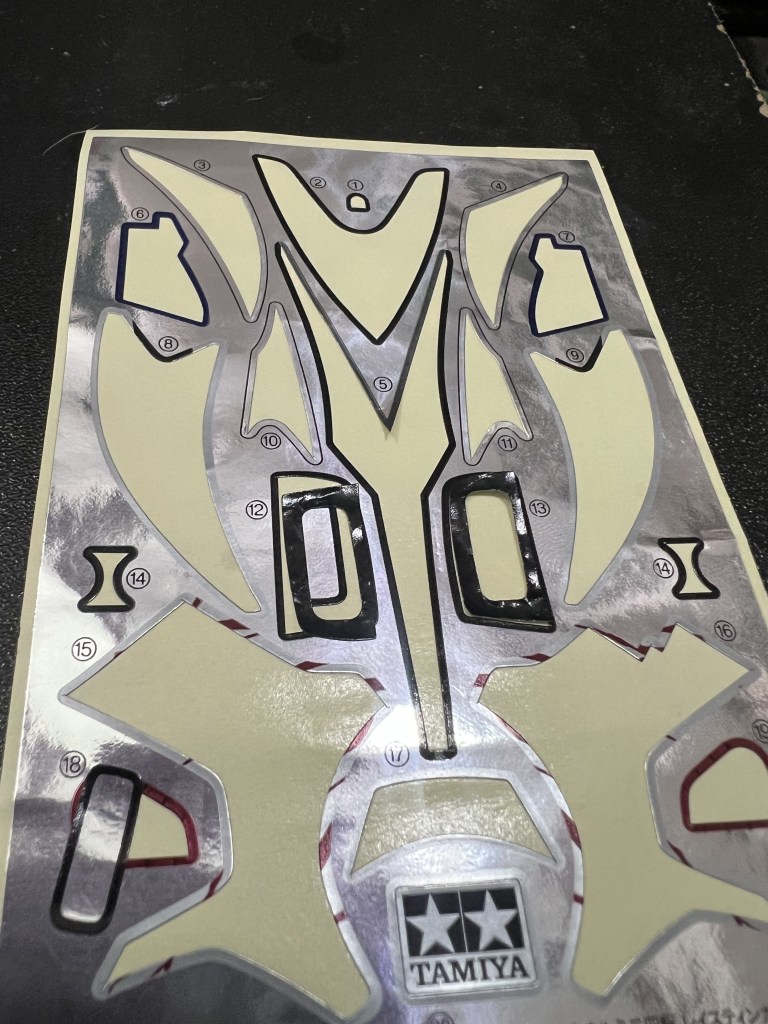
The Ray Stinger decals looked beautiful on the sheet.
They were also absolutely unforgiving.
There was one large black sticker that I could not get right no matter how many times I tried. I placed it, removed it, adjusted it, removed it again, and repeated the process until the adhesive started giving up before I did.
Eventually, I had to accept that the sticker was not going to cooperate.
Instead of forcing it onto the body and watching it peel off later, I decided not to use every decal.
It bothered me at first because I wanted the car to look exactly like the box art.
But I also did not want to ruin the entire body over one stubborn sticker.
So I let it go.
Mostly.
Even after the sticker disaster, I still felt proud when I finally turned the car on.
Once again, it worked.
Compared to the Geo Glider, Ray Stinger felt much more raw.
Because the chassis was lighter and thinner, I could feel the vibration of the gears and motor more clearly in my hands. It was louder too. The whole car felt like it had more attitude.
I was not brave enough to let it loose on the floor this time.
It looked too light, too fragile, and too fast for me to risk sending it straight into another wall.
So I held it instead and listened to the gears spin.
The Geo Glider felt solid and planted.
Ray Stinger felt alive.
Overall, Ray Stinger was a success.
You might think that the simpler chassis would make it feel like a downgrade from the more modern FM-A Geo Glider.
It did not.
Building the Super II chassis felt like walking backward through Tamiya’s history.
It helped me understand how much Mini 4WD design had changed over time. The rear-mounted motor, the lighter construction, and the simpler layout all felt closer to the cars I remembered from childhood.
More importantly, it made me even more curious.
How many other chassis were out there?
How different would they feel?
Would the next car be lighter, heavier, wider, or even more complicated?
The Geo Glider introduced me to the hobby.
Ray Stinger made me want to understand it.
Curiosity had officially taken the wheel.
Historian’s Note
This was the first time I chose a Mini 4WD for more than just its appearance.
Yes, Ray Stinger looked cool. The silver body, black flames, and villain energy definitely helped.
But the real reason I bought it was because the words Super II Chassis made me ask questions.
I had started noticing that the chassis mattered just as much as the body sitting on top of it.
That curiosity eventually became one of the main reasons I stayed in the hobby.
The Geo Glider made me want another car.
Ray Stinger made me want to know why every car felt different.


Leave a Reply